Other road users
From the Rules of the Road published by the Road Safety Authority (RSA). iTest.ie is not affiliated with the RSA — check rsa.ie for the latest edition. Read in the app (contents, picks up where you left off) →
In this section
Emergency services vehicles
In the course of their duty, Garda, fire brigade vehicles or ambulances and other emergency vehicles can be exempt from some of the road traffic law as long as this does not put other road users in danger. As a user of the road, if you hear or see a Garda or emergency vehicle approaching under emergency conditions using a siren or flashing lights, you should exercise caution, and give way if it is safe to do so. Never ‘tailgate’ an emergency service vehicle (see pages 164–165).
People using agricultural machinery
Tractors
Tractors are governed by normal road traffic laws on driver licensing, insurance, motor tax and vehicle lighting.
All tractors used in a public place must be fitted with safety frames. The purpose of the frame is to protect the driver from being crushed underneath if the tractor overturns. The frame must comply with approved standards.
It is up to the owner or driver to fit a safety cab.
Tractor drivers must carefully transport loose material such as silage, slurry, sand or gravel, so that the material does not spill onto a public road and cause a crash. Loads of lime or other dusty materials, offal or other offensive material must be fully covered with a tarpaulin.
Farmers using agricultural tractors and trailers to haul agricultural produce must not:
- use exceptionally high frames on trailers which could endanger the stability, steering and braking of an agricultural tractor and trailer combination; or
- exceed the maximum legally permissible combination weight or the design gross vehicle weight.
For more information visit the website www.rsa.ie.
Please note:
Further rules relating to various aspects of agricultural vehicles, such as lighting requirements, weight and dimension requirements, speed disc requirements, among others, are now in place. Information on these new rules can be found on www.rsa.ie.
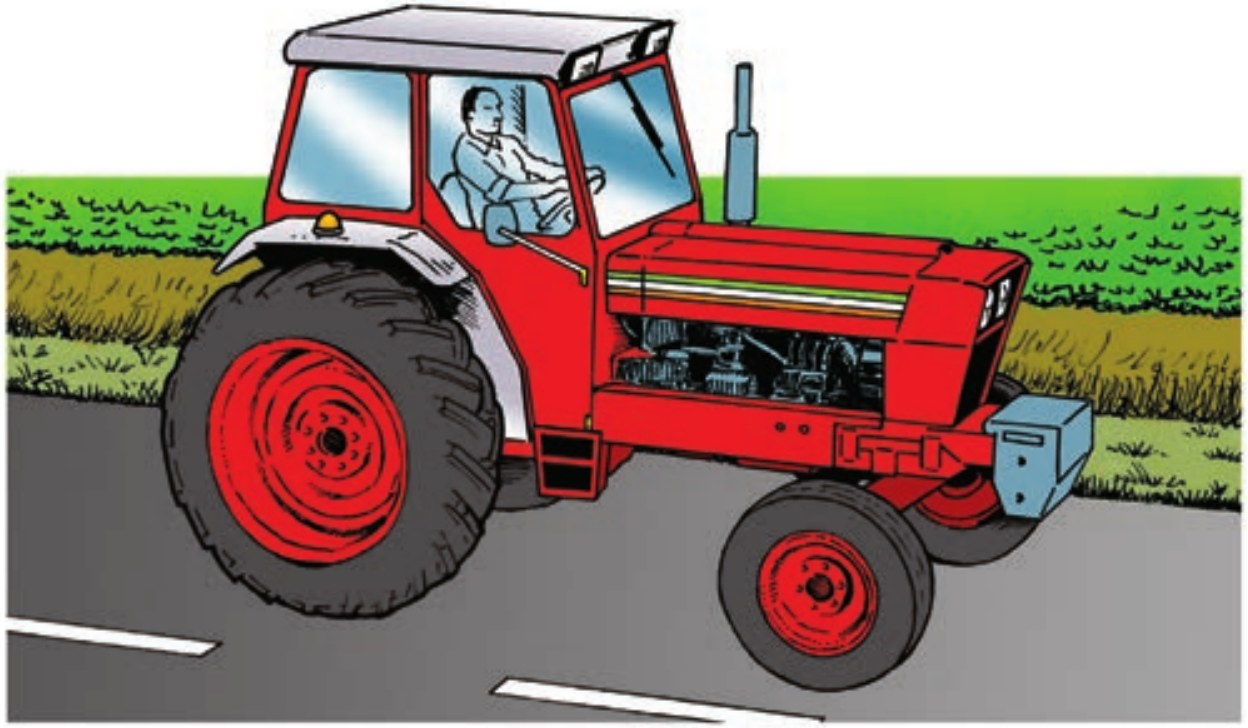
Tractors on the road
A tractor used in a public place must obey the laws governing road traffic.
If you are driving a tractor, you should keep left to let faster traffic pass. Your driving mirror must provide an adequate view of the road behind you.
Do not carry a passenger unless the tractor is equipped to carry one.
People in charge of animals
Horse-drawn vehicles
The normal rules apply, including the general rule to keep left. The hand signals to be given by the driver are the same as those given by a cyclist (see Section 7). A horse-drawn vehicle must be equipped with two red rear reflectors and, at night, must also carry on the right-hand side of the vehicle a lamp showing a white light to the front and a red light to the back.
You must not drive a horse-drawn vehicle while under the influence of alcohol or drugs.
Riding or leading horses
If you are riding or leading a horse, you must remain on the left-hand side of the road and obey all Rules of the Road.
You should wear a high-visibility vest and an approved riding helmet.
When leading a horse, you should walk so as to ensure that you are between the horse and the traffic, so as to prevent the horse from interfering with the traffic.
When riding one horse and leading a second horse, you must remain on the left-hand side of the road. You should ensure the led horse is on the left-hand side of the ridden horse, to ensure that you are positioned between the horse and the traffic. This is in order to control the led horse, in the interest of the safety of other users of the road.
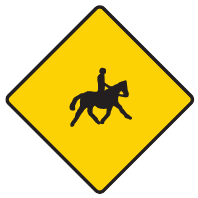
Drivers should take special care when:
- approaching riding schools or places where horses are likely to appear,
- overtaking horses, especially loose horses or horse-drawn vehicles, and
- approaching a horse and rider. If appropriate a driver must stop a vehicle and allow them to pass.
Driving animals on the road
If you are in charge of animals on a roadway, you must take reasonable steps to make sure the animals do not block other traffic or pedestrians.
If you are in charge of animals on the road at night, you should carry a lamp showing a white light to the front and a red light to the back. You should also wear a reflective armband.