Parking
From the Rules of the Road published by the Road Safety Authority (RSA). iTest.ie is not affiliated with the RSA — check rsa.ie for the latest edition. Read in the app (contents, picks up where you left off) →
In this section
This section covers the rules on parking safely.
Parking
General rules
- Where possible, park facing in the direction of traffic flow.
- Park close to, and parallel with, the kerb or edge of the road, except at any location where straight or angled parking bays are marked out on the surface of the road.
- Where a parking bay is marked out on a road, you must park your vehicle fully within the parking space.
- Apply the handbrake.
- Switch off the engine.
- Leave the vehicle in first gear or reverse, or, in the case of an automatic, select P.
- Before opening any doors, check for other road users nearby, in particular motorcyclists, cyclists and pedestrians.
- Open your doors only when you need to and keep them open only for as long as necessary.
- Get out of your vehicle only when it is safe and you and your passengers are not blocking other road users.
- Passengers should exit on the kerbside.
- Lock your vehicle as you leave it.
- You should not leave headlights on when parked.
How to make sure your vehicle is parked safely
Make sure you do not interfere with normal traffic flow and that your vehicle does not disturb, block or endanger other road users.
| Dos ✓ | Don’ts ✗ |
|---|---|
| Do park as close as possible to the kerb or edge of the road. | Don’t park opposite another vehicle on a narrow road. |
| Do make sure the sides of your vehicle are parallel to the kerb or edge, unless a traffic sign indicates otherwise. | Don’t double park. |
| Do park facing in the same direction as the traffic. | Don’t park at roadworks. |
| Do make sure your vehicle can be seen at night. | Don’t park at the entrance or exit of a fire station, Garda station, ambulance station or hospital. |
| Do park courteously, without blocking other road users’ views of a traffic signal or the road ahead. | Don’t park where you would block other road users’ views of a traffic signal or the road ahead. |
| Do park where you would not block the entrance to a property unless you have the owner’s permission. | Don’t park where parking is forbidden by traffic signs or road markings (see section 6). |
| Don’t leave headlights switched on when parking at the side of the road, or just off the side of the road. |
REMEMBER
Drivers can quickly become dazzled and disorientated by headlights of parked or stopped vehicles. If you need to have lights on in these circumstances, you should use only ‘side’ or ‘parking’ lights. You should not leave headlights on when parked.
The following traffic signs and road markings show where parking is not allowed or is allowed only at certain times.
Traffic signs
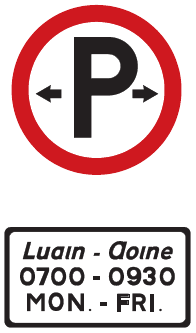
These signs and their information plates show that you can park only during certain periods (sign 1) or outside certain periods (sign 2).
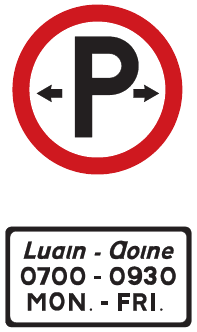
Parking permitted
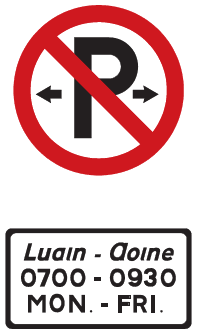
Parking prohibited
The sign below shows a clearway – an area of road that must be kept clear for moving traffic during certain times of the day (usually busy periods). The times when stopping or parking is prohibited are shown on an information plate under the sign.
Other vehicles may stop during these times only if they are waiting in a line of traffic, but they are not allowed to park, even if disc or metered parking is normally available.
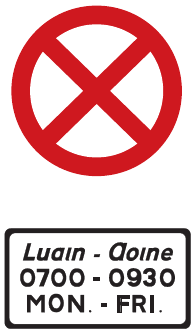
Road markings
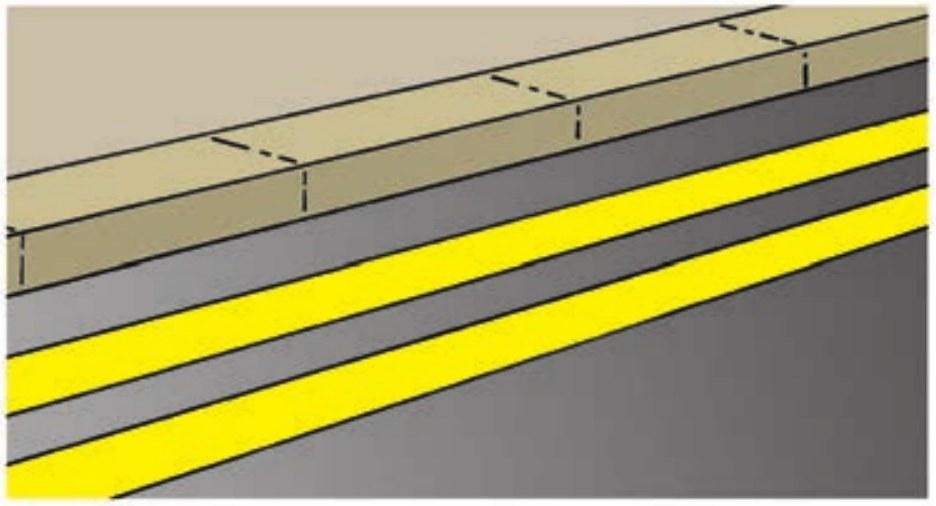
This single yellow line usually has an upright information plate nearby. Together, the road marking and information plate mean you must not park during the times shown.
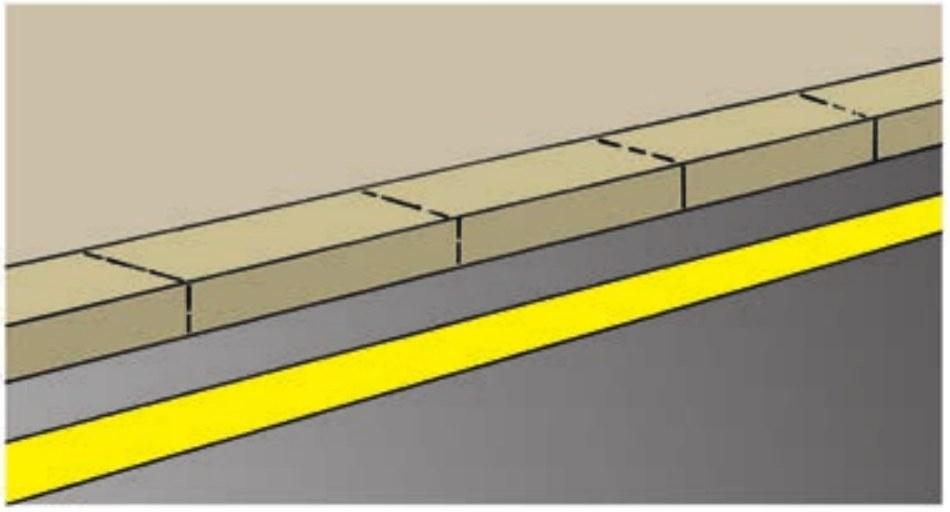
The double yellow lines mean no parking at any time.
No parking
Even if you do not see a particular ‘no parking’ sign or yellow line on the road, you must not stop or park:
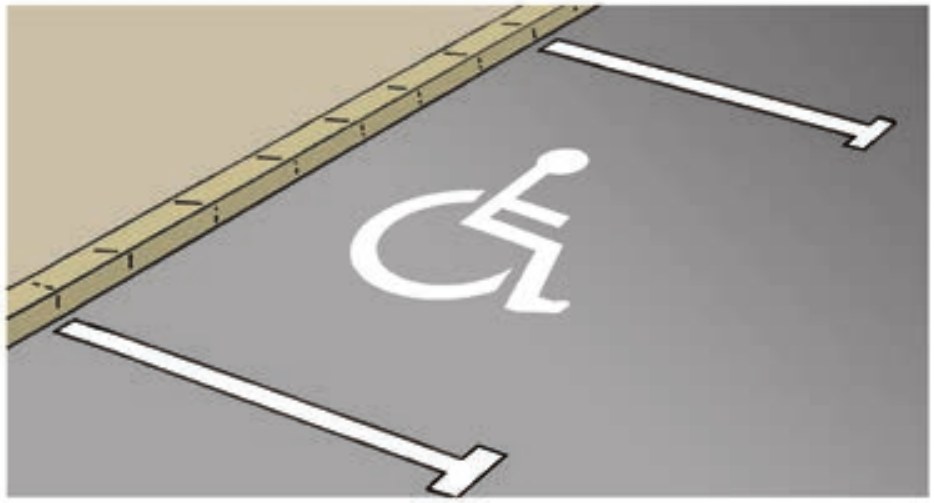
- in a designated disabled persons parking space unless you display a ‘reserved for a person with a disability’ permit. Wheelchair users need to use the extra-wide, special parking bay to open their car door fully. This will allow a person to get from a wheelchair to a vehicle or from a vehicle to a wheelchair. Normal parking bays are too narrow to give the access needed by wheelchair users, so other road users must not park in the designated disabled persons parking spaces. It is an offence to do so.
- where there are white or yellow zig-zag lines on either side of pedestrian lights or either side of pelican or zebra crossings;
- wholly or partly on a zebra or pelican crossing or at pedestrian lights;
- 15 metres before or 5 metres after a pedestrian crossing or traffic lights;
- near a school entrance where there are yellow zig-zag lines along the edge of the roadway enclosing the words ‘SCHOOL KEEP CLEAR’;
- near an entrance or exit from a Fire, Ambulance or Garda station;
- within an area marked as a bus stop or taxi rank - white roadway markings line the areas and, in addition show the word ‘BUS’ at a bus stop and ‘TAXIS’ at a taxi rank;
- where there is a single or double continuous white line along the centre of the road;
- wholly or partly on a footpath, a grass margin, a cycle lane or track or a median strip;
- within 5 metres of a road junction unless parking spaces are clearly marked;
- on a part of a road reserved for casual trading during trading hours;
- in a contra-flow bus lane at any time or in a with-flow bus lane during the hours the bus lane is in force;
- in a loading bay (reserved for goods vehicles to use while loading or unloading goods for a maximum period of 30 minutes) – roadway markings show the word ‘LOADING’ repeated across the entrance of the parking area;
- in an entrance or exit for vehicles to or from a premises, unless authorised by the occupier of the premises;
- in a tram lane during the period the tram lane is in force (tram lanes operate on a 24-hour basis unless an alternative period is shown on an information plate beside the lane);
- on the approach to a level crossing;
- where the kerb has been lowered to help wheelchair users.
REMEMBER
You must not park in any way which interferes with the normal flow of traffic, or which obstructs or endangers other road users.
You must never park:
- at a corner, a bend, the brow of a hill or on a hump-back bridge;
- where there is a sharp dip in the road; or
- anywhere that blocks the view of a school warden or junior school warden service – this restriction does not apply to a vehicle displaying a disabled persons parking permit.
Disc parking
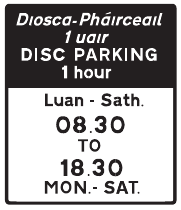
Disc parking operates in built-up areas to restrict parking during certain times of the day. You will see the regulatory sign and information plate pictured below in areas covered by disc parking. When you park, you must buy a disc for a set period of time and leave the parking space by the time this period ends. You must not park again in the same street within one hour of leaving a disc-parking space. The restriction does not apply to a vehicle displaying a parking permit for a person with a disability.
Clamping or removing vehicles
Some local authorities have introduced systems to combat illegal parking. If your vehicle is parked illegally, a clamp may be fixed to a wheel, or your vehicle may be towed to another place and have a clamp attached there, or your vehicle could be removed and locked up in a vehicle pound. You must then pay a fee to remove the clamp or have your vehicle returned to you.
Dangerous parking
If you park in a way that is likely to cause danger to other road users, for example, if it forces a pedestrian out onto the roadway, a Garda can decide that you have committed an offence of dangerous parking, for which you may be liable to a fixed charge of €80 and up to 5 penalty points.
REMEMBER
Always ensure not to endanger other road users – particularly vulnerable road users – when parking. In particular, never park on a footpath.