Rules for pedestrians
From the Rules of the Road published by the Road Safety Authority (RSA). iTest.ie is not affiliated with the RSA — check rsa.ie for the latest edition. Read in the app (contents, picks up where you left off) →
In this section
Pedestrian deaths account for 1 in 5 deaths on our roads. This section covers the rules on walking along and crossing roads.
The most important rule for all pedestrians is to behave responsibly, exercise care and not endanger or inconvenience other users of the road.
Walking beside or along a road
- If there is a footpath, you must use it.
- If there is no footpath, you must walk as near as possible to the right-hand side of the road (facing oncoming traffic).
- Do not walk more than two abreast. If the road is narrow or carries heavy traffic, you should walk in single file.
- You should always wear bright and hi-viz clothing during the day and reflective clothing at night when walking outside built-up areas.
- You should always carry a torch when walking at night time.
- You should always be aware of other road users.
Crossing the road
Follow the DOs and DON’Ts below to make sure you cross the road safely.
| Dos ✓ | Don’ts ✗ |
|---|---|
| Do look for a safe place to cross. | Don’t cross at a corner or bend in the road. |
| Do stop and wait near the edge of the path. If there is no path, stand close to the edge of the road. | Don’t cross near the brow of a hill. |
| Do look right and left and listen for traffic. | Don’t cross near or at parked vehicles. |
| Do let any traffic coming in either direction pass, then look right and left again. | Don’t cross where there are guard rails along the footpath. |
| Do walk briskly straight across the road when it is clear. | Don’t hold onto or climb onto moving vehicles |
| Do continue to watch and listen for traffic while crossing. | Don’t run across the road. |
Taking care near buses or trams
Take extra care if crossing a road where there is a bus lane (especially a contra-flow bus lane), cycle lane or tram track. You should also be careful when getting on or off buses and when crossing the road at or near bus stops.
REMEMBER
Never cross in front of a stopped bus.
Safe crossing places
Use the following places to cross the road safely.
Zebra crossing
This is marked by yellow flashing beacons. The actual crossing area is marked by black and white ‘zebra’ stripes.
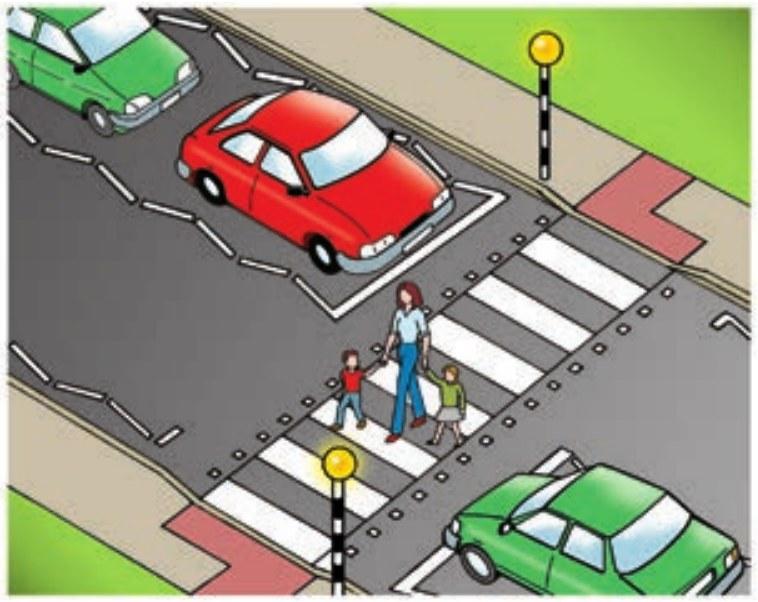
Drivers must stop to let you cross. As they approach the crossing, they should slow down and be prepared to stop. They must stop behind the stop line if there is one and must not enter any part of the crossing.
Drivers must not overtake or park within areas covered by zig-zag markings on either side of the crossing. Section 10, on parking, has more information.
- You do not have the right-of-way over other traffic until you actually step onto the crossing. Never step onto the crossing if this would cause a driver to brake or swerve suddenly.
- You must not cross within the area marked by zig-zag white lines if these are provided on either side of a zebra crossing. If they are not provided, you must not cross within 15 metres of the crossing.
- If there is a central island, treat each side as a separate crossing.
- Always watch carefully for approaching traffic. Place one foot on the crossing to indicate that you wish to cross. Wait until traffic has stopped before you start crossing.
Pedestrian lights
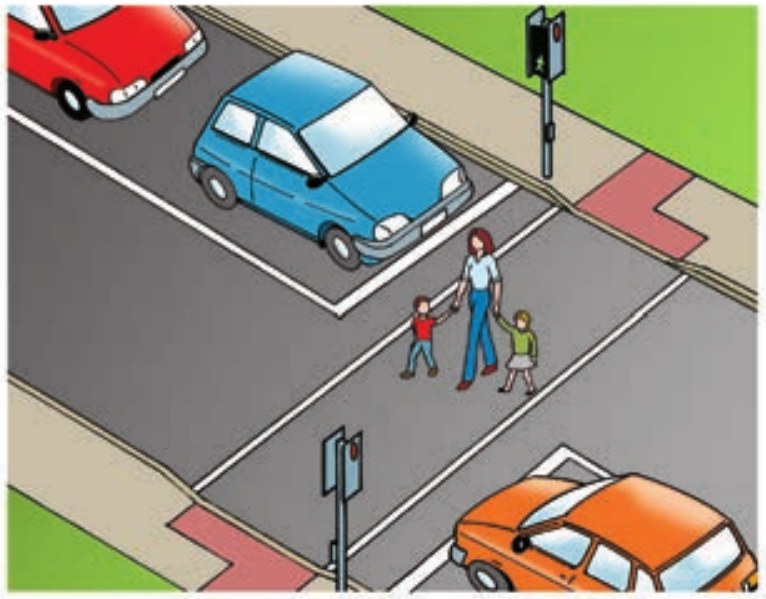
Pedestrian lights consist of a set of traffic lights for drivers and a set of light signals for pedestrians. Usually there is a push button for pedestrians. When you press it, the traffic lights will turn to red after a short while.
- Do not cross while the ‘wait’ or ‘red man’ light is showing.
- Cross with care when the ‘cross now’ or ‘green man’ is showing.
- If there is a central island at the pedestrian lights, the ‘green man’ or ‘cross now’ sign will let you cross only as far as that. You must then press the push button at another set of lights to cross the rest of the way.
- For vision-impaired pedestrians, an audible bleep signal or a vibrating panel on the push button may be in place to indicate when it is safe to cross.
Pelican crossing
At this crossing, an amber light will flash for a short period after the red light for drivers goes out. Similarly, the ‘green man’ light for pedestrians will flash for a short time before changing to the ‘red man’ light. A flashing amber light at a pelican crossing gives priority to pedestrians on the crossing.
Traffic lights
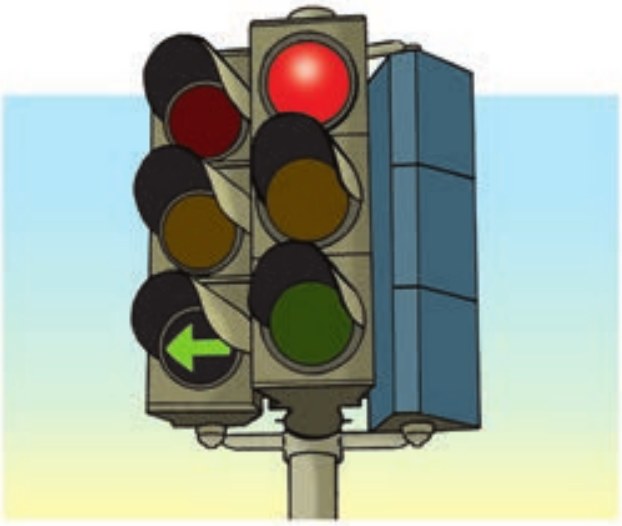
If you are crossing at traffic lights, but there are no signals for pedestrians, check the lights in both directions. When the traffic on the road you wish to cross is governed by a red light, cross carefully. Look out for traffic that might be turning onto the road you wish to cross and remember that some traffic lights allow traffic to proceed in some lanes when other lanes are stopped. Be especially careful at junctions with filter lanes.
Uncontrolled crossing places
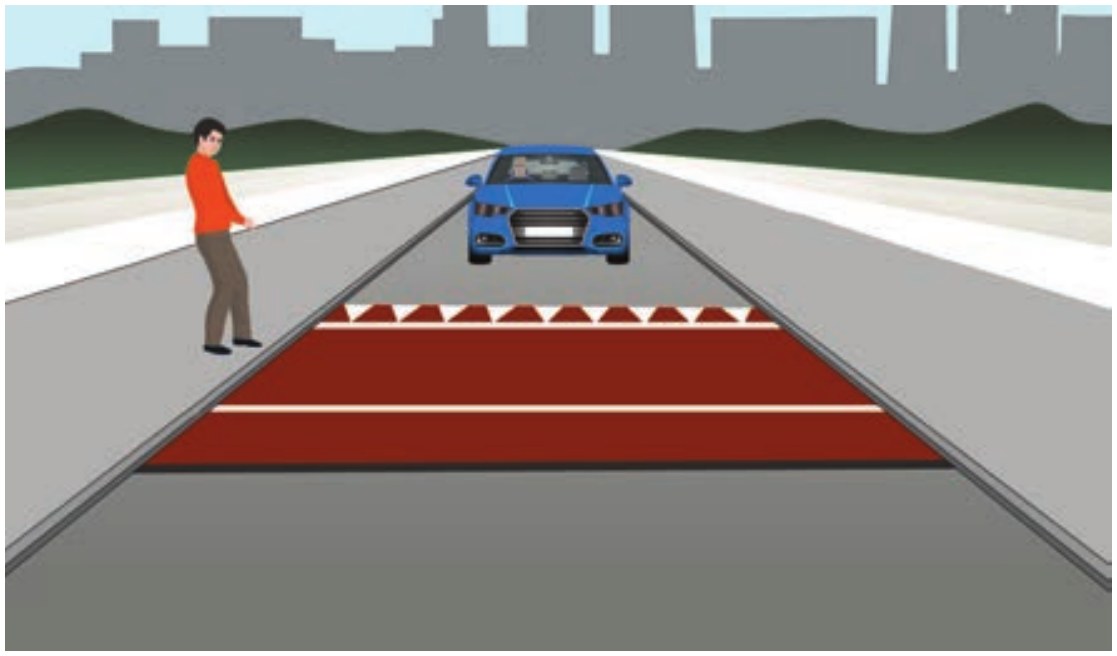
Generally uncontrolled crossing places (courtesy crossings) are designated shared areas of road. They are coloured, slightly raised or patterned cobbled sections of road, and drivers should be aware of the potential dangers of pedestrians approaching or crossing on them.
It is also important to point out that pedestrians do not have an automatic right of way when using these crossings. Pedestrians need to be alert and aware that traffic may suddenly approach from either direction.
Pedestrians
Pedestrians should only enter uncontrolled crossing places (courtesy crossing) ensuring that all traffic is aware of their presence if crossing the road.
Motorists
Motorists entering uncontrolled crossing places (courtesy crossing) should react by driving very slowly, aware of the potential dangers of pedestrians using the area.
A traffic island can be provided to help pedestrians. These are safer places to cross because the crossing is divided into two parts.
Don’t cross the road in the area in front of a truck. This is a truck driver’s blind spot.
REMEMBER
If you can’t see the driver, they can’t see you.