Rules for cyclists
From the Rules of the Road published by the Road Safety Authority (RSA). iTest.ie is not affiliated with the RSA — check rsa.ie for the latest edition. Read in the app (contents, picks up where you left off) →
In this section
- Keeping your bicycle roadworthy
- Bicycle checklist
- Protective clothing and equipment
- When buying a helmet:
- When you own a helmet you should:
- Bicycle trailers
- Cycling safely
- Cycle tracks
- Rules on cycle tracks for other road users
- Driving
- Parking
- Cycling offences included in the fixed charge system
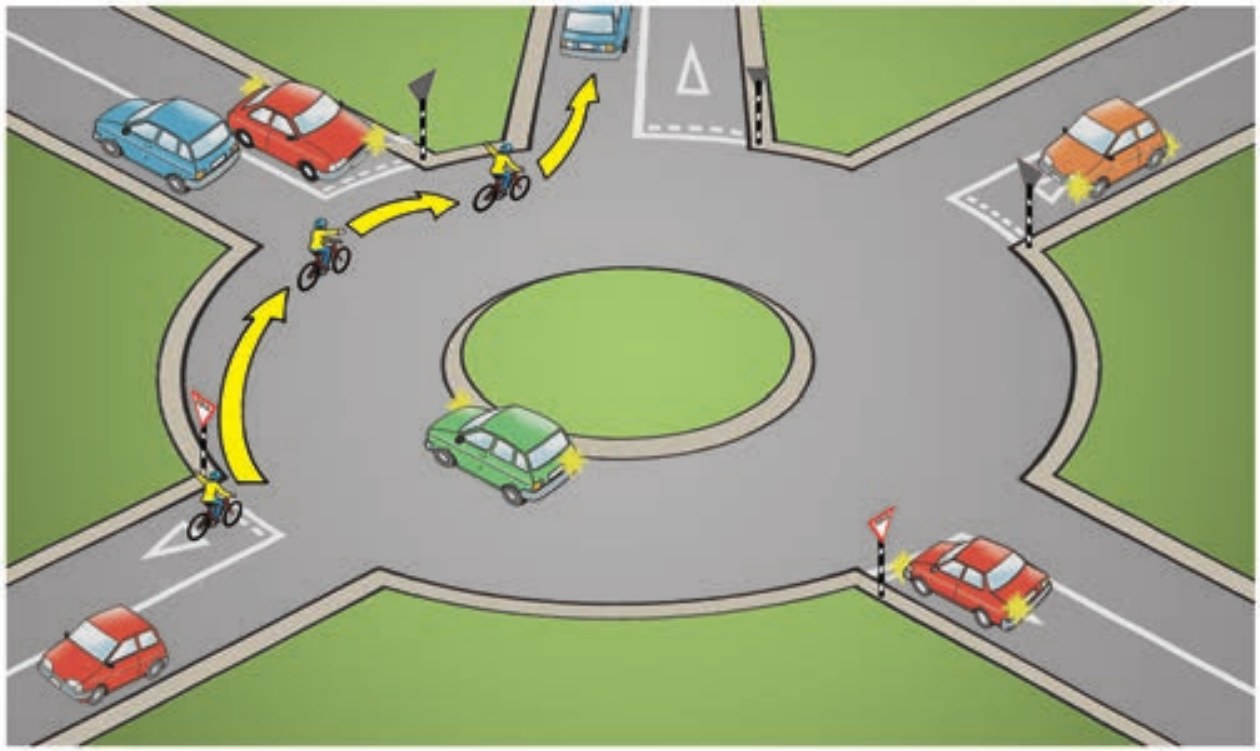
- Cyclists on roundabouts
This section covers the rules for keeping your bicycle roadworthy, wearing proper equipment and cycling safely and considerately. You must also be familiar with the rules on cycle tracks (see pages 194–195) and hand signals (see Section 7).
Keeping your bicycle roadworthy
- Your brakes, tyres, chain, lights, reflector and bell must all be in good working order.
- Your bicycle should be the right size to allow you to touch the ground with both feet.
- When carrying goods, you should use a proper carrier or basket and take care that nothing is hanging loose.
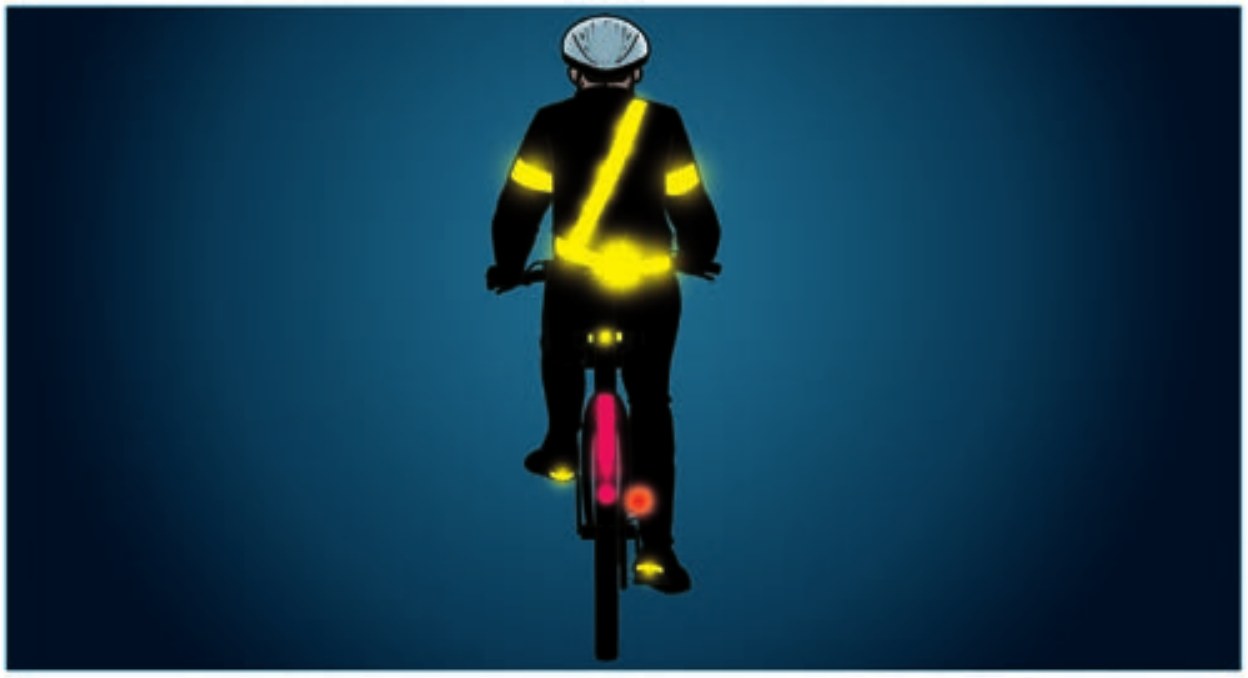
- At night you must carry a lamp showing a white or yellow light to the front and a lamp showing a red light to the back. These are the minimum lighting requirements laid down by law. However, to be even more visible to motorists at night, you should:
- add strips of reflective material to the bike (white to the front and red to the back);
- wear a reflective armband; and
- wear a ‘Sam Browne’ reflective belt or reflective vest.
REMEMBER
Check your gear, be seen, wear a helmet and listen – never listen to music or use radios or mobile phones when cycling.
Bicycle checklist
- Handlebars should be square with the frame and level with the saddle. Movement should be neither too stiff nor too loose.
- When on the saddle, both feet should just touch the ground.
- Your wheels should be straight and in line. Replace wheels if they are buckled or out of alignment.
- Tighten loose spokes and replace any that are damaged.
- Make sure your tyres are properly inflated, with a good tread.
- Make sure mudguards are secure and well clear of the wheels.
- Check your gears and get them adjusted when necessary.
- Check your brake cables and adjust them when necessary. Replace them when frayed.
- Make sure the closed ends of brake shoes face the front.
- Make sure brake blocks are close to the rim of the wheel. Replace worn blocks.
- Check pedals and replace them when worn or broken.
- Make sure your lamps are white or yellow to the front, and red at the back. Use a red reflector. Replace batteries when necessary and clean lenses.
- Make sure your bell is within easy reach of your thumb.
- Oil all moving parts.
- Wear a cycle helmet at all times.
A bicycle should have the following braking system:
- If it has one fixed wheel or is designed for a child under 7 years of age, it must have at least one brake.
- If it is designed for an older child or an adult, or if neither wheel is fixed, it must have two brakes – one brake acting on the front wheel and another for the back wheel.
Protective clothing and equipment
As a cyclist, you are a vulnerable road user and your bicycle will not protect you if there is a crash. The law does not require you to wear a helmet. However, in the interest of road safety, and in your personal interest, you should wear a helmet when cycling.
When buying a helmet:
- Look for a mark to show that it has been made to a recognised national standard.
- Check that it does not restrict your field of vision or your hearing.
When you own a helmet you should:
- Replace it when it is damaged or dropped.
- Adjust the straps on your helmet to fit you correctly. Always check the manufacturer’s instructions.
Bicycle trailers
Carrying children on bicycles exposes them to the dangers of the road.
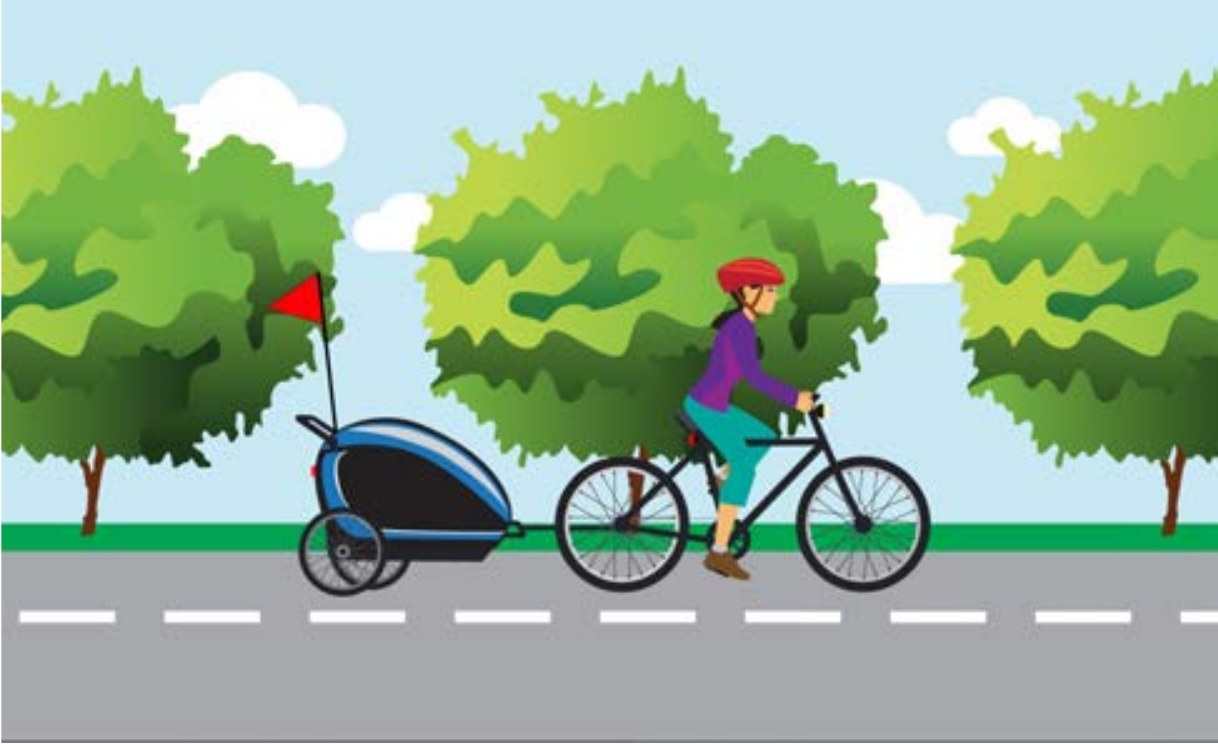
Bicycle trailers are generally low to the ground. Due to their low profile, HGV and car drivers may not be aware of them immediately behind the bike. To help counteract this, a flag pole should be attached to the rear of the trailer with the flag being approximately level in height with the rider’s helmet. For overall safety, the trailer should display two red lights (one each side of the trailer), especially when travelling in poor lighting conditions. Towing a trailer will have an adverse effect on the handling of a bicycle. The way you corner may have to be adapted, and stopping times may increase as a result of the increased weight of the trailer. In busy urban areas you will have to take account of the extra width, especially in cycle tracks where you might take up the full width of the lane.
If you intend to use a child seat for carrying a child on your bicycle, make sure that it is fit for purpose and securely fitted by a competent person. Make sure your child is wearing a suitable cycle helmet and check that the seat’s restraining straps are in good condition. Be aware of the risk of your child’s feet getting caught in the wheel spokes. The seat should have secure foot straps. Ensure clothing like scarfs and shoe laces cannot get caught in the wheels.
Cycling safely
- Positioning: You may need to move out from the normal secondary position on the road (left side of the lane) to a more primary riding position (centre of the lane) in order to:
- get the best view of the road and junctions ahead.
- increase visibility for approaching traffic, especially where a driver’s view may be blocked.
- turn left or right, enter a roundabout, change lanes or approach a bend.
Before changing position on the road, you should ‘look, signal in good time and look again’ to ensure that it is safe to proceed. If you are not confident in taking up the ‘primary’ position, it may be safer to get off the bike and cross the roadway on foot where it is safer.
- Make sure you keep to the left. Always look behind and give the proper signal before moving off, changing lanes or making a turn.
- You must obey the rules of the road, particularly those that relate to traffic lights, pedestrian crossings, pelican crossings and zebra crossings.
- Keep both hands on the handlebars except when signalling or changing gears.
- Keep both feet on the pedals.
- Do not take up a position on the ‘inside’ of a large vehicle out of view of the driver. Instead, stay behind if the large vehicle has stopped at a junction with the intention of turning left.
- Keep clear of the kerb – riding clear will make you more visible and help reduce unsafe overtaking.
- When turning left, keep close to the left-hand side of the road, watch out for pedestrians and give the proper signal in good time.
- Beware of blind spots – all vehicles have blind zones and a driver may not be able to see you!
- If you cannot see the driver, the driver cannot see you, so stay back and stay safe.
- When turning right, get into the centre or just left of centre of the right-turning lane. This helps to prevent a vehicle overtaking you whilst you are changing direction. Look behind and give the proper signal before you move out and ensure traffic in that lane is not going straight ahead. On steep hills or busy roads, pull into the left-hand side of the road and wait until there is a break in traffic in both directions to let you make the turn safely.
- When cycling alongside traffic stopped in line, be aware of gaps in the traffic to allow other vehicles to turn across the stationary lane. The view of the car that is turning may be blocked due to the traffic build-up.
- In poor weather conditions, or if you are not confident about taking up the position for turning right as outlined above, it may be safer to get off your bike and cross the roadway on foot. Where available, you should use a pedestrian or controlled crossing.
- Wear reflective clothing at all times.
REMEMBER
Cyclists put themselves and other road users at risk when they do not stop as required at traffic lights.
In the company of one or more cyclists, you must have due regard to other users of the road, and you must take full account of prevailing road conditions. Sometimes it may be safe to cycle two abreast, but you must not cycle in a manner likely to create an obstruction for other road users.
Cycle tracks
A cycle track or lane is a reserved part of a roadway for bicycles and wheelchairs, but not motorcycles.
Some cycle tracks are bordered by a continuous white line on the right-hand side. These are only for bicycles and motorised wheelchairs, so no other drivers may use them or park in them.
Other cycle tracks have a broken white line on the right-hand side. Other drivers may make temporary use of this type of track if there is no cyclist on it.
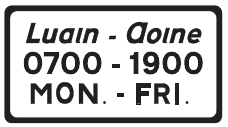
Cycle tracks are reserved 24 hours a day, unless an upright information sign at the start of or the side of the track shows another period of time.
A cycle track can also be a reserved part of a footpath or other area off the road.
If a cycle track is two-way, meaning bicycles travelling in opposite directions at the same time can use it, cyclists should stay as near as possible to the left-hand side of their track.
You must obey cycle track lights.
REMEMBER
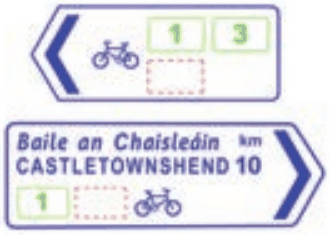
Cyclists should wherever possible use any cycle track provided.
Rules on cycle tracks for other road users
Driving
No vehicle (other than a motorised wheelchair) may cross into or over a mandatory cycle track unless the driver is entering or leaving a place or a side road. A mandatory cycle track is a cycle track that is bounded by a continuous white line.
Parking
No driver may park a vehicle in a mandatory cycle track.
A driver may park in a non-mandatory cycle track for up to 30 minutes, but only if they are loading or unloading their vehicle and there is no alternative parking available. Remember the basic duty of care and do not obstruct a cycle track.
If a driver parks their vehicle in a cycle track that operates for only some of the day (shown on an information plate under the cycle track sign), they must move the vehicle by the time the next operating period starts.
If there is no information plate, it means the cycle track operates all the time and no parking is allowed.
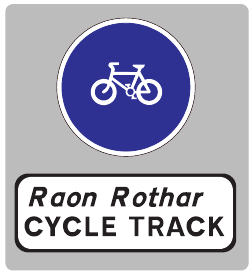
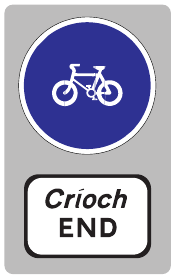
The table below sets out some ‘Dos’ and ‘Don’ts’ in relation to particular road traffic rules on cycling.
| Dos ✓ | Don’ts ✗ |
|---|---|
| Do cycle in single file when overtaking. | Don’t ever ride or attempt to ride a bicycle while under the influence of alcohol or drugs. |
| Do allow extra space when overtaking parked vehicles as the doors may open suddenly. | Don’t ever ride on or across a footpath, other than where a cycle track is provided on the footpath. |
| Do cycle in single file if cycling beside another person would endanger, inconvenience or block other traffic or pedestrians. | Don’t ever hold on to a moving vehicle. |
| Do cycle in single file in heavy traffic | Don’t ever cycle side-by-side with more than one cyclist. |
| Do give your name and address, if requested, to a Garda. | Don’t ever cycle against the flow of traffic on one-way streets. |
| Do obey signals given by a Garda or school warden. | Don’t ever cycle through red traffic lights or pedestrian lights. |
| Do obey all rules applying to road traffic signs and road markings, including signs and signals at traffic lights, pedestrian crossings, pelican crossings, level crossings and zebra crossings. | Don’t ever cycle on a motorway. |
| Do know the meaning of hand signals for cyclists and use them when cycling. | Don’t ever cycle in a contra-flow bus lane, unless signs authorise it. |
| Do be aware of the extra reaction time and stopping distance that may be required when riding an electric bike. | Don’t ever cycle without appropriate lighting during hours of darkness. |
Cycling offences included in the fixed charge system
| Description of Offence | Fixed Charge |
|---|---|
| Cyclist driving a pedal cycle without reasonable consideration | €40 |
| No front lamp or rear lamp lit during lighting-up hours on a pedal cycle | €40 |
| Cyclist proceeding into a pedestrianised street or area | €40 |
| Cyclist proceeding past traffic lights when the red lamp is illuminated | €40 |
| Cyclist failing to stop for a School Warden sign | €40 |
| Cyclist proceeding beyond a stop line, barrier or half barrier at a railway level crossing, swing bridge or lifting bridge, when the red lamps are flashing | €40 |
The table below lists the actions that you should take or avoid taking in the interests of your safety and that of other road users.
| Dos ✓ | Don’ts ✗ |
|---|---|
| Do keep well back when cycling behind a motor vehicle in slow-moving traffic. | Don’t ever hold on to or lean against stationary vehicles. |
| Do take extra care on wet or icy roads or when it is windy. | Don’t ever weave in and out of moving traffic. |
| Do use your bell as a warning device only. | Don’t ever carry a passenger unless your bicycle has been built or specially adapted to carry one. |
| Do take extra care and look well ahead for uneven road surfaces, drains and other obstructions so that you do not have to swerve suddenly in front of another vehicle. | Don’t ever use a personal entertainment system when cycling. |
| Do use a bus lane, and be extra vigilant when a bus is stopped and about to move off from the stop. | Don’t ever use a mobile phone while cycling. |
Cyclists on roundabouts
- Be particularly careful when approaching a roundabout.
- Be aware that drivers may not see you easily.
- Watch out for vehicles crossing your path as they leave or enter the roundabout.
- Take extra care when cycling across exits.
- Give plenty of room to long vehicles on the roundabout, as they need more space. Do not ride in the spaces they need to use to get around the roundabout. Be aware of the driver’s blind spots. If you can’t see the driver, they can’t see you. It may be safer to wait until they have cleared the roundabout before you go on it.