Assisting Gardaí
From the Rules of the Road published by the Road Safety Authority (RSA). iTest.ie is not affiliated with the RSA — check rsa.ie for the latest edition. Read in the app (contents, picks up where you left off) →
In this section
An Garda Síochána are responsible for enforcing road traffic law. This section covers the Garda signals and instructions you must obey when on the road.
Signals
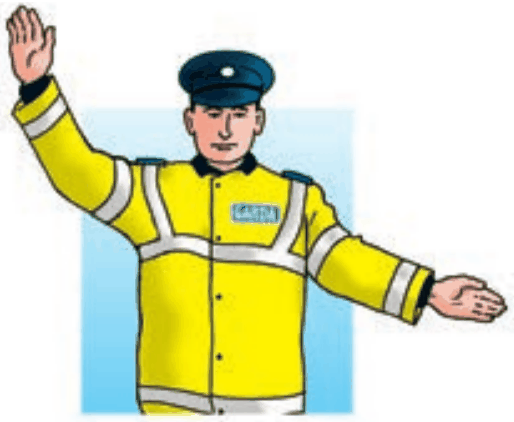
If a Garda is controlling traffic, their signals override all other signals from traffic lights. This means that if they signal you to stop, for example, you must do so even if a green light is showing. The signals and their meanings are shown below. You must understand them so you know how to respond when in traffic.
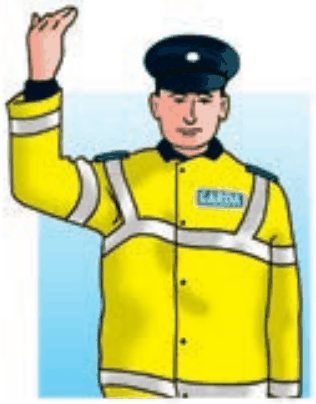
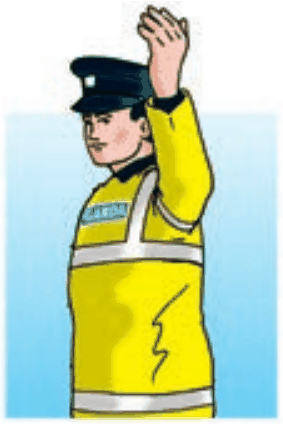
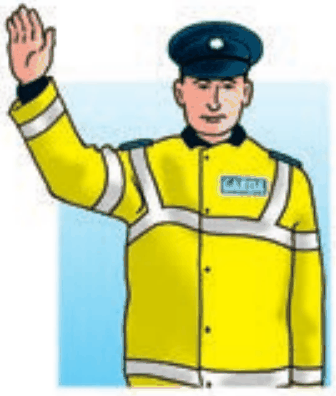
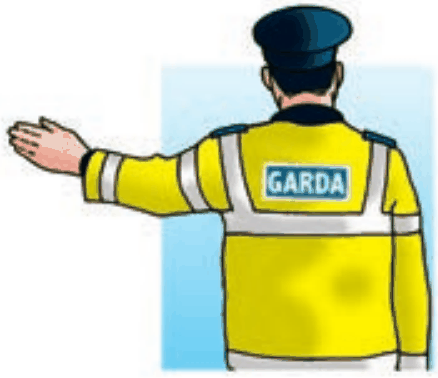
Instructions
You must do the following if a Garda asks you to:
- Show your driving licence, which you must carry at all times when driving.
- Allow the Garda to examine the insurance disc, tax disc and, where relevant, the NCT and CVRT disc, all of which you must display on your vehicle.
- Produce a certificate of roadworthiness or NCT certificate, as appropriate, at a named Garda station within 10 days.
- Produce a valid motor insurance certificate to a Garda within 10 days of it being requested. A Garda may ask to see a valid motor insurance certificate any time up to a month after observing or reasonably believing that an uninsured vehicle has been used in a public place.
- Produce the vehicle registration certificate at any reasonable time.
- Stop your vehicle and allow a Garda to check it for defects.
- Give your name and address.
- Write out your signature.
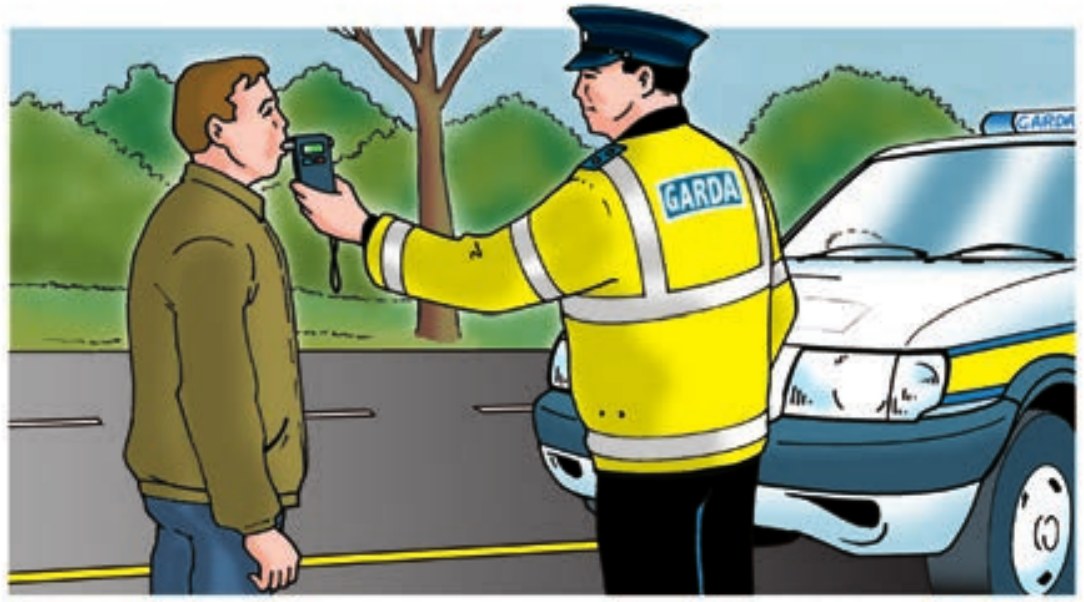
- Give a sample of your breath or saliva. You may be required to provide a roadside breath or saliva sample at any time when requested by a member of An Garda Síochána.
- Perform ‘impairment tests’. You may be required to perform impairment tests where a Garda suspects that you are driving under the influence of drink or drugs. Before conducting such a test, a Garda will ask whether you have any disability or medical condition which you think might prevent you from participating in the relevant test.
A Garda may conclude from observing your ability to perform these tests that your ability to drive is impaired. It is an offence to refuse to perform impairment tests if required by a Garda.
Gardaí can set up checkpoints to take roadside breath samples without the need to form the opinion that you have consumed an intoxicant. It is a criminal offence to refuse to provide a sample.
If you are arrested for an offence related to alcohol and driving or refusing to give a roadside breath sample, you will be required to provide a sample of breath and blood or urine at a Garda station.
Gardaí may also require you to permit a nurse or doctor to take a blood or urine sample from you in situations where you have been involved in an accident in which you were driving and are attending at hospital. It is an offence to refuse to allow a doctor or nurse to take a sample in such situations (unless the doctor or nurse themselves refuse to take the sample on medical grounds).
Where a person is incapable of complying with this above requirement (for example, the driver is unconscious), the Gardaí may direct the doctor or nurse to take a sample of blood from the person. It is an offence for a person to refuse permission for that blood sample to be subsequently tested (unless they have a special or substantial reason for their refusal).
If a doctor advises the Garda that the taking of either a urine or blood sample from the person may adversely affect that person’s health, the Garda will not make the above requirement of a person or give the above direction to a doctor or nurse.
Other controls on road users
- Officials from the Revenue Commissioners, including Customs, may also stop and examine vehicles.
- Your vehicle may also be impounded by a Revenue Official or Gardaí.
- You may also be stopped by the Gardaí working with Transport Officers from the Road Safety Authority who will check the tachograph and Operator’s Licence.
What to do when an emergency service vehicle approaches
You need to know what to do when you see an emergency vehicle. You must react quickly, safely and carefully to allow emergency service vehicles to pass.
It is important to be alert and attentive at all times. You should keep noise levels in your vehicle at a level that allows you to hear the sirens from emergency vehicles.
Be alert at intersections and observe your surroundings as emergency service vehicles may come from behind you or from a secondary road.
You should also leave plenty of space between you and the vehicle in front when stopped in traffic. This will give you room to manoeuvre your vehicle if, for example, you need to pull in to let the emergency service vehicles pass – something you cannot do if you are sandwiched between two vehicles in traffic.
Gardaí, fire fighters and ambulances save lives in the course of their work and every second counts when they are responding to an emergency.
When an emergency vehicle approaches:
- Clear the way as soon as you can do so safely when you see the flashing lights or hear the sirens.
- Never mount the kerb unless you absolutely have to and, even then, only if you are certain that there are no pedestrians there.
- Check your rear mirror and both side mirrors to gauge the speed of the emergency vehicle and also look out for pedestrians, cyclists, motorcyclists and other road users. Indicate your intention to pull over. Pull over only in a place which has enough space for the emergency vehicle to pass you safely.
- Stay there until the emergency vehicle has passed. Watch out for other emergency vehicles as there may be more than one.
- Take the appropriate observations and then indicate that you are going to pull out again. When it is safe to do so, gradually merge back into traffic.
Never ever:
- Tailgate or overtake an emergency vehicle with lights or sirens unless directed to do so.
- Race after an emergency service vehicle to get through a traffic light.
- Break a red light or speed to allow emergency service vehicles to pass you unless you’re directed to do so by the Gardaí or emergency service personnel.
- Brake suddenly or block the road.
- Overtake a moving emergency service vehicle that is displaying flashing lights.
Pedestrians, cyclists and motorcyclists
Pedestrians, cyclists and motorcyclists should look and listen for emergency service vehicles.
It is important to think about the route of the emergency service vehicle to make sure that you are not in its path. Keep in as far as possible on the correct side of the road.
If you are a pedestrian and there is an embankment or grass verge, you should use it (if it is safe to do so) in order to keep out of danger. If you are pushing a pram or buggy, this may not be possible so make sure that you keep in as far as possible. Try to anticipate the route that the emergency service vehicle is taking and attempt to alert the emergency service vehicle to your presence on the road.
If you have children with you, make sure that you are holding their hands at all times. It is important to wear hi-viz clothing at all times to make sure other road users can see you. Pedestrians should always wait until emergency service vehicles have passed before crossing the road at traffic lights, pedestrian lights, zebra crossings or pelican crossings.
For more information see ‘Sharing the Road with Emergency Service Vehicles – some basic tips’, available from www.rsa.ie.