Factors that affect safe driving
From the Rules of the Road published by the Road Safety Authority (RSA). iTest.ie is not affiliated with the RSA — check rsa.ie for the latest edition. Read in the app (contents, picks up where you left off) →
In this section
The main factors that can affect your driving are:
- alcohol;
- drugs (prescription and non-prescription);
- tiredness and fatigue;
- road rage or other forms of aggression.
Individually or together, these factors will:
- affect your judgment;
- slow your ability to react to and avoid hazards;
- cause you to lose concentration; and
- make you a less safe and socially responsible driver.
Alcohol
Alcohol is a major factor in crashes that lead to death and injury.
Research proves that even small amounts of alcohol affect your judgment and ability to drive.
REMEMBER
The only safe advice is to NEVER EVER drink and drive. Could you live with the shame?
There is no reliable way to tell how much you can drink before you exceed the legal limit. Our best advice is to never ever drink and drive. Please check the current levels at www.rsa.ie.
Penalties for drink driving
Once stopped by An Garda Síochána, a driver may be tested for alcohol and taken to a Garda station for further testing. In all cases, if a driver fails a preliminary breath test at the roadside, they will be arrested and required to provide an evidential breath, blood or urine specimen at a Garda station.
The offence of refusing to provide a sample of breath, blood or urine for evidential purposes will attract an automatic disqualification of four years for a first offence and six years for a second or subsequent offence.
Under the system, if a driver is not already disqualified from holding a driving licence or a learner permit at the time of detection, or has not availed of the fixed penalty notice option in the preceding three years, and the BAC (Blood Alcohol Concentration) levels in the body do not exceed 100mg (qualified, non novice or non professional) or 80 mg (learner, novice or professional) they will be subsequently served with a fixed penalty notice. Court proceedings will not be initiated if payment of the fixed charge is made and the disqualification accepted.
The penalties which apply are:
- If a driver is tested and their BAC is between 50mg and 80mg, the driver will be served an on-the-spot fixed penalty notice, receive a fine of €200 and an immediate 3 month disqualification. The driver cannot drive in a public place the entire of the 3 month calendar period. To drive while banned is a criminal offence and will lead to prosecution.
- If a driver is tested and their BAC is between 80mg and 100mg, they will be served an on-the-spot fixed penalty notice, receive a fine of €400 and will be disqualified from holding a licence for six months.
- If a driver who is a learner, novice or professional driver is tested, and they are above the 20mg limit (but less than 80mg), they will be served with an on-the-spot fixed penalty notice, receive a fine of €200 and be disqualified from holding a driving licence for three months.
Where a driver is tested and their BAC is above 100mg (or 80mg for a learner, novice or professional driver), or they have failed to pay a fixed penalty notice, they will have to go to court where the disqualification periods range from 1 to 6 years depending on the level of alcohol detected, and whether it is a first or subsequent offence.
REMEMBER
Never ever drink and drive.
Drugs
It is against the law to drive a car, motor bike, truck, bus, pedal bike or an animal-drawn vehicle while ‘under the influence of an intoxicant to such an extent as to be incapable of having control of the vehicle’.
Intoxicants include alcohol and drugs, whether taken separately or together. The word ‘drugs’ here includes legal prescribed and over the counter (OTC) medicines.
If a Garda suspects you of driving under the influence of drugs, they may require a saliva sample and for you to perform ‘impairment tests’. Before conducting such tests, a Garda will ascertain whether you have any disability or medical condition which you think might prevent you from participating in the relevant test. These impairment tests may involve the performance of the following five tests:
- a ‘pupil dilation’ test;
- a test of your ability to balance;
- a ‘walk and turn’ test;
- a ‘one leg stand’ test; and
- a ‘finger to nose’ test.
It is an offence to refuse to perform impairment tests if required by a Garda.
A Garda may conclude from observing your ability to perform these tests that your ability to drive is impaired and consequently arrest you. The results of these tests may be used as evidence, along with any blood or urine samples taken and tested for the presence of any drugs, in order to convict you of driving while under the influence of an intoxicant.
The Gardaí can use preliminary drug testing devices, called the Drager Drug test 5000, at the roadside or in a Garda station to test a person’s oral fluid for Cannabis, Cocaine, Opiates and Benzodiazepines. If positive, a blood specimen can be taken, which will be sent to the Medical Bureau of Road Safety (MBRS) for evidential testing.
If the Garda forms the opinion that you are impaired and you have not had a preliminary drug test, or the results of that test were negative, they can request either a blood or urine specimen, which will be sent to the Medical Bureau of Road Safety for testing.
The penalty for drug driving is the same as for drink driving – a maximum of €5,000 fine and up to 6 months imprisonment on summary conviction.
In terms of disqualification periods, for those convicted of the new offence of being above the threshold for cannabis, cocaine and heroin with no proof of impairment necessary by the Gardaí, the disqualification period is not less than 1 year for the first offence, and not less than 2 years for the second or subsequent offence.
For the existing offence of drug driving while impaired, there is no change to the penalty or disqualification periods, which are a minimum of 4 years for a first offence and 6 years for a second or subsequent offence.
Driver tiredness and fatigue
You should not drive while tired or fatigued. Research has shown that tired drivers are a major road safety risk, both to themselves and to others.
If you are tired and fighting sleep, you are likely to experience ‘micro sleeps’. These episodes can last up to 10 seconds and can be experienced even when your eyes are open.
During a micro-sleep of even 4 seconds, your car can travel 100 metres (more than the length of a football pitch) without you being in control of your vehicle.
All drivers are at risk from driver tiredness but the following drivers are particularly high risk:
- Night workers
- People driving home after a night shift
- Lorry drivers
- Company car drivers
- Men (particularly those aged 18–24 and 50+)
- Skilled manual workers
Truck drivers fall into several of the above high-risk groups and need to be particularly careful.
Advice for drivers:
- Never drive if you are fighting sleep.
- Prepare yourself for driving by ensuring you get enough sleep.
- If you are on any medication, check if it causes drowsiness.
- Prepare your journey properly, and plan where you can take a safe break from driving.
- Stop in a safe place when you feel tired.
- Drink a cup or two of strong coffee or a caffeinated drink and take a nap for a maximum of 20 minutes (set the alarm on your mobile phone). Caffeine takes about 20 minutes to take effect, so if you nap for more than 20 minutes, you might wake feeling groggy.
- After the nap, if it is safe to do so, get some fresh air and stretch your legs.
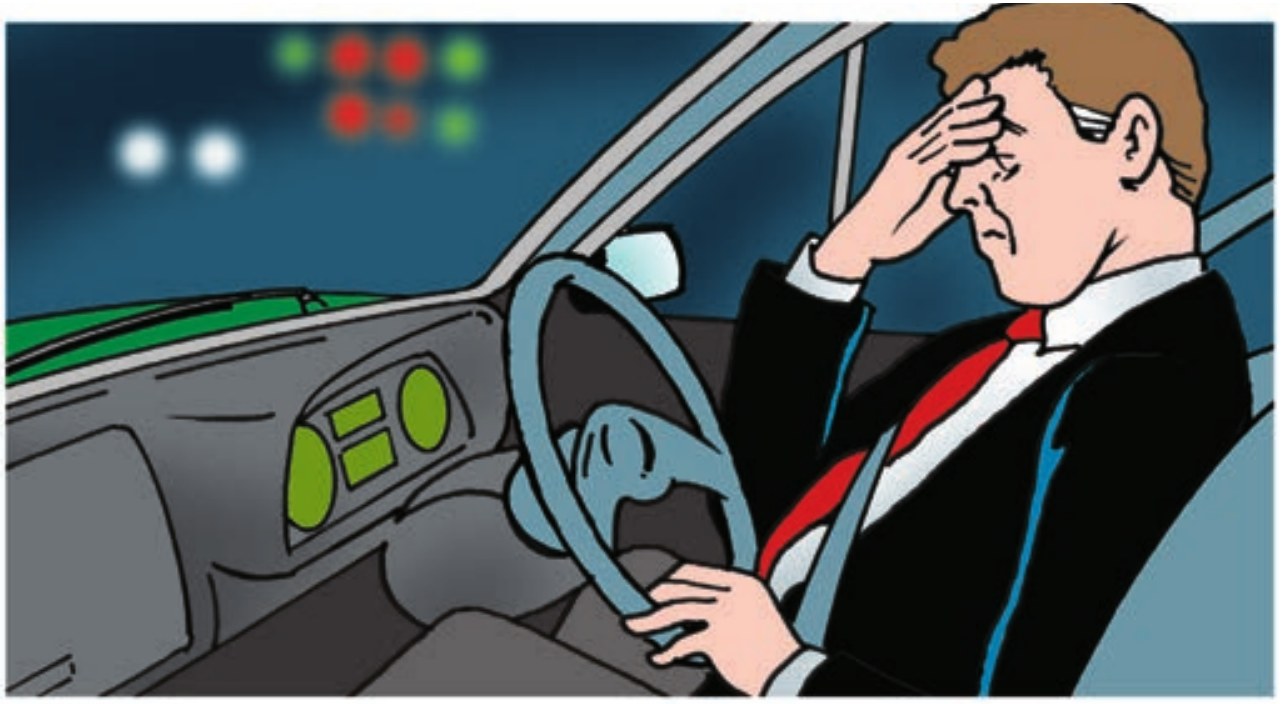
Note: these measures should only be considered in an emergency and should not be used on a regular basis. If you are a professional driver, you should consider what long-term steps you need to take which will help you to get the sleep that you need.
Do not be tempted to keep driving when you are tired because you are only minutes from your destination. Many tiredness-related collisions occur within a few minutes of the driver’s destination as the body begins to relax.
For further advice and information on Driver Tiredness, see RSA leaflet ‘Driver Tiredness’ which is available to download on www.rsa.ie.
REMEMBER
If you are suffering from a serious lack of sleep, the only cure is sleep.
Road rage and aggressive driving
If you display road rage as a driver, it means you have uncontrolled anger that results in intimidation or violence against another driver.
Aggressive driving is inconsiderate, stupid driving. It can involve speeding, tailgating (driving too close behind another vehicle), failing to use an indicator for lane changes, recklessly weaving in and out of traffic and over-use of a horn or flashing headlights.
If another driver is attempting to provoke you, don’t react. Don’t be tempted to speed up, brake or swerve suddenly. This could cause a crash or make other drivers think you are confronting them. Instead, stay calm and remain focused on your driving to complete your journey safely. Always remember that safety is your number one concern.
Report all incidents to your local Garda station or contact Traffic Watch on: Lo-Call 1890 205 805.
Litter
Remember: Throwing litter from a vehicle is not only irresponsible but can cause a hazard to other road users and yourself.
REMEMBER
It is an offence to supply a mechanically propelled vehicle to anyone who is under 16 years of age for use in a public place. Similarly, it is an offence to drive a vehicle whilst under age and without the necessary driving licence or learner permit. The word ‘supply’ means sell, hire, loan, gift or provide in any other way. If you do, you can be fined up to €5,000 or face up to six months’ imprisonment.