The learner driver
From the Rules of the Road published by the Road Safety Authority (RSA). iTest.ie is not affiliated with the RSA — check rsa.ie for the latest edition. Read in the app (contents, picks up where you left off) →
The Road Safety Authority has produced a suite of manuals to help learners as they learn to drive a car, a truck or a bus, or ride a motorcycle.
Conditions for learner permit holders
When you are a learner driver you must, in addition to answering yes to the questions on pages 24–25, comply with the following conditions:
1) Accompanied when driving
- A holder of a learner permit for categories B, BE, C, C1, C1E, CE, D, D1, D1E and DE must be accompanied and supervised at all times by a qualified driver. A qualified driver is a person who has held a full driving licence in the same category for a continuous period of 2 years. A learner driver detected of driving unaccompanied faces an €80 fine and two penalty points if paid within 28 days, a €120 fine and two penalty points if paid within the next 28 days and €120 and four penalty points if convicted in court.
- If you hold a learner permit for category AM, A1, A2 and A does not need to be accompanied by a qualified driver. However, you cannot drive a vehicle in this category unsupervised by your Initial Basic Training (IBT) instructor until you have completed the IBT for your relevant category and type of motorcycle.
- A vehicle being driven by an unaccompanied learner driver can be seized by Gardaí.
- The owner of a vehicle who allows an unaccompanied learner or unlicensed driver to drive their vehicle is liable to have their vehicle seized by the Gardaí and could face a fine of up to €1,000.
- A lower threshold of penalty points leading to disqualification will apply to any driver who is granted their first learner permit on or after 1 August 2014 while they drive under a learner permit, and subsequently during the first two years while they drive under their first full driving licence.
2) ‘L’ Plates
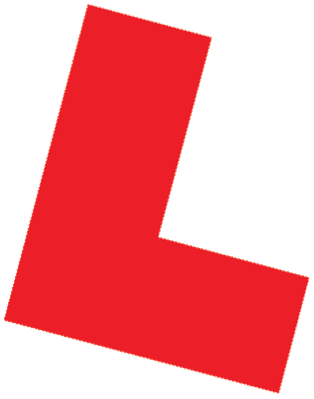
- Learner permit holders for all categories (except W) must display ‘L’ plates while they are driving. It is an offence for a learner driver to drive without displaying ‘L’ plates. This offence attracts a penalty of a fixed charge fine and up to 4 penalty points.
- Learner permit holders for categories A, A1, A2 and AM must display ‘L’ plates on a yellow fluorescent tabard that are clearly visible on the front and back of the driver’s body.
3) Essential Driver Training and Initial Basic Training
It is illegal to give driving instruction for payment or reward to learner drivers if you are not registered with the Road Safety Authority. A list of all Approved Driving Instructors (ADI) is available on www.rsa.ie.
4) Car Driver Training
All holders of their first learner permit issued from 4 April 2011 must undertake Essential Driver Training (EDT) with an Approved Driving Instructor (ADI). [See www.rsa.ie for an up to date list of ADIs.]
EDT is a training course that teaches fundamental driving skills to learner car drivers. The course is made up of 12 individual one-hour sessions.
At each EDT session, your ADI will check your learner permit, and if you are using your own car, will check to make sure your insurance, motor tax, NCT and roadworthiness of the vehicle are all in order. In addition you should request from your ADI your official EDT Logbook, which you are responsible for and should take along to each lesson. The logbook must be completed including an official stamp, instructor’s and student’s signatures, and returned to the student at the end of each EDT session.
You can check on www.rsa.ie/myedt for EDT sessions completed.
A Sponsor is a qualified driver who supervises any driving outside of formal lessons and tracks practice sessions in your logbook.
You will need lots of practice and additional driving lessons with an ADI to become a safe and responsible driver.
Be sure to confirm with your ADI what type of lesson you are booking for your next lesson. Not all lessons are EDT.
5) Reduced Essential Driver Training (EDT) Programme
The Reduced EDT programme is a mandatory driver training programme for drivers from outside Ireland who currently hold a full valid Category B licence, but from a country which does not have a licence exchange agreement with Ireland.
Drivers who through the NDLS have established their eligibility to avail of the mandatory Reduced EDT programme will be required to complete EDT sessions 1, 5, 6, 7, 9 and 10 before taking the Irish driving test.
Drivers who are eligible for the Reduced EDT programme will not be required to wait 6 months before taking the Irish driving test.
6) Motorcycles and Initial Basic Training
All new first time learner permit holders for motorcycles must undertake Initial Basic Training (IBT) with an approved IBT instructor, before they can ride a motorcycle unsupervised.
IBT is a training course that teaches basic riding skills to learner motorcyclists. The basic IBT is a 16-hour course broken into 4 modules focusing on theory and practical skills, to be taken in sequence.
When you have completed each IBT Module of your IBT course, your instructor will record the details of your training in your logbook. Once all modules have been completed, your ADI will issue you with a Certificate of Satisfactory Completion.
You must keep your certificate with your learner’s permit and carry it with you whenever you are riding as you may be asked to produce it by the gardaí.
After you get your certificate, you can apply for your practical driving test.
[If you want to upgrade the bike you ride you may need to complete a ‘progression module’. Visit www.rsa.ie for more details.]
Until they hold their full licence, motorcyclists must carry their IBT certificate when riding without an IBT trainer.
6) Motorways
As a learner permit holder, you must not drive on a motorway. It is an offence to do so.
7) Trailers
Learner permit holders driving vehicles in Categories B, C, C1, D or D1 (cars, trucks or buses) must not tow a trailer.
8) Carrying Passengers
- A person who holds a learner permit for any category must not carry any passenger for payment or reward.
- A person who holds a learner permit for category W (for example, a work vehicle or land tractor) must not carry a passenger unless the vehicle is constructed or adapted to carry a passenger and the passenger is a qualified driver.
- A person who holds a learner permit for category A1, A2, A or AM (motorcycle or moped) must not carry a passenger.
9) Motorcycles
Category A2 learner permit holders are entitled to drive motorcycles with:
- An engine power output of 35kW or less, or
- A power to weight ratio of 0.2kW per kg or less.
It is your responsibility to check the power of the motorcycle. If you are in any doubt, consult with the dealer or manufacturer.
If your learner permit runs out
No matter what type of motor vehicle you drive, you may get a third and subsequent learner permit only if you show that you have taken a driving test within the previous two years.
If you have not taken the test, you must:
- give evidence that you applied to sit your driving test for that category of vehicle; or
- satisfy the NDLS that because of illness (as certified by a registered medical practitioner), you were not in a position to take a driving test.
If you are a first time holder of a learner permit for categories A, A2, A1, AM, B or W, that is, if you haven’t held a learner permit in the category before, or a previous permit has expired by more than five years, you are not allowed to take a driving test for at least six months after the start date of the permit. This provision is to allow you to gain experience of driving. Research shows that the longer a learner is supervised while driving, the less likely they are to be involved in a collision.
This rule does not apply to:
- category BE vehicles;
- a higher category of motorcycle where you have passed Initial Basic Training (IBT) and a driving test on a lower category of motorcycle and you hold the category for a minimum of 2 years;
- a holder of a current full driving licence in the category from another country for more than six months, provided the holder forwards to the RSA a current original full driving licence and a letter of entitlement from the recognised licensing authority in that country.
REMEMBER
The drink-drive limit for learners, newly qualified drivers (for a period of two years after passing the driving test) and professional drivers such as bus, goods vehicle and public service vehicle drivers (PSV) is 20 milligrams (mg) of alcohol per 100 millilitres of blood.
Never ever drink and drive.